Proverbs 28:13
Whoever conceals their sins does not prosper, but the one who confesses and renounces them finds mercy.
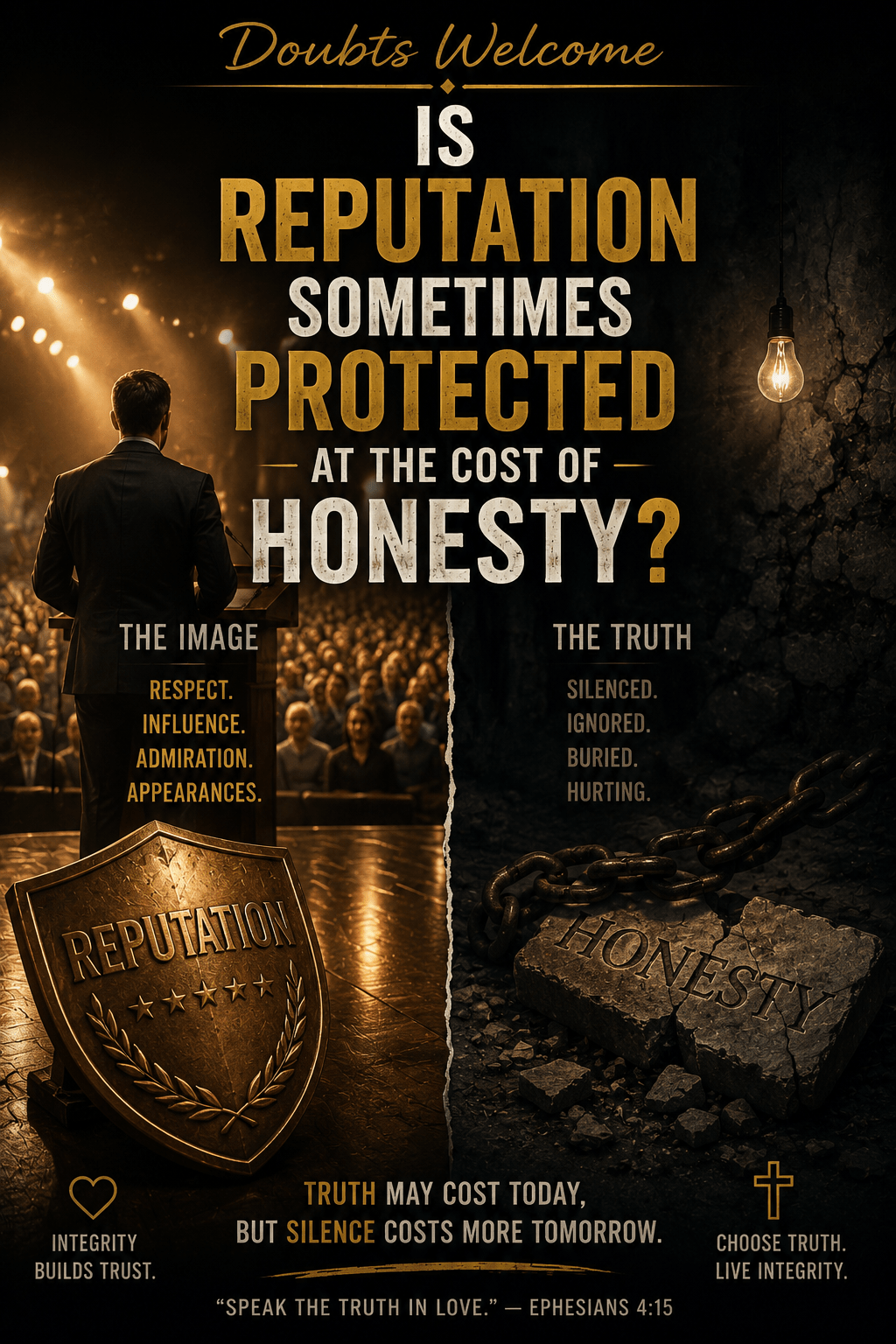
If we’re honest… yes.
And it happens more often than people like to admit.
Sometimes in friendships.
Sometimes in families.
Sometimes in workplaces.
And sometimes, even in church.
Because reputation is powerful.
It shapes how people see us.
How we are respected.
How we are trusted.
And when reputation becomes deeply tied to identity, success, leadership, or influence, protecting it can start to feel more important than telling the truth.
That’s where the tension begins.
Because honesty can be costly.
It can expose flaws.
Mistakes.
Failure.
And many people fear what honesty might change.
“What will people think?”
“What if trust is lost?”
“What if everything changes?”
So instead of confronting truth directly, it sometimes gets softened, hidden, delayed, or avoided altogether.
Not always out of evil intentions.
Sometimes out of fear.
Fear of embarrassment.
Fear of consequences.
Fear of losing status or influence.
But even when the intentions feel understandable, the result can still be damaging.
Because when reputation is protected at the expense of honesty, trust begins to break down.
And trust is difficult to rebuild once people realise truth was sacrificed to maintain appearance.
The problem is that image can become easier to protect than integrity.
Especially in environments where appearances matter.
Where being respected is highly valued.
Where leadership is idealised.
Where people feel pressure to look “good” spiritually, morally, or publicly.
In those spaces, honesty can start to feel threatening.
So instead of transparency, there’s performance.
Instead of accountability, there’s protection.
Instead of truth being addressed early, it’s often managed quietly in order to preserve reputation.
And the longer that happens, the bigger the gap becomes between appearance and reality.
But the truth is:
Protecting reputation without honesty rarely leads to healing.
It usually leads to deeper damage later.
Because what stays hidden often grows.
And when truth finally comes to light, people are often hurt not only by the original issue—but by the lack of honesty surrounding it.
Especially in church settings, this tension can become deeply painful.
Because faith calls people toward truth, repentance, humility, and integrity.
Yet sometimes institutions or individuals become more focused on preserving image than confronting reality honestly.
And that creates confusion.
Because how can truth be preached publicly… while avoided privately?
How can accountability be expected from some… but resisted by others?
These are difficult questions.
But they matter.
Not because people are looking for perfection—
but because honesty builds trust.
The reality is, everyone makes mistakes.
Everyone falls short.
Everyone has weaknesses.
The issue is not imperfection.
The issue is whether honesty is valued enough to face imperfection truthfully.
Because integrity isn’t about never failing.
It’s about being truthful when failure happens.
And maybe that’s what people are really longing for.
Not flawless leaders.
Not perfect communities.
But honest ones.
Spaces where truth matters more than image.
Where accountability is real.
Where confession isn’t seen as weakness.
Where humility is valued more than reputation.
Because ironically, protecting reputation at all costs often destroys the very thing people are trying to preserve.
Why?
Because trust is built more through honesty than through image.
People can handle imperfection.
What becomes harder to trust is deception, avoidance, or hiddenness.
And this doesn’t only apply to institutions or leaders.
It applies to all of us.
How often do we protect how we appear instead of being honest about who we are?
How often do we avoid difficult conversations because we fear what honesty may expose?
How often do we manage perception instead of dealing with reality?
These are uncomfortable questions.
But maybe they’re necessary.
Because growth begins where honesty begins.
Not surface-level honesty.
Not selective honesty.
Real honesty.
The kind that requires humility.
The kind that says:
“I was wrong.”
“I need help.”
“This isn’t okay.”
And while that kind of honesty can feel costly in the moment, it often creates the possibility for real healing.
Because healing can only happen where truth is allowed to exist.
So maybe the question isn’t simply:
“Is reputation being protected?”
Maybe it’s:
“What is it costing?”
Because if protecting an image requires sacrificing honesty…
then eventually, something deeper begins to break.
And maybe real integrity isn’t about appearing perfect.
Maybe it’s about being truthful enough to be real.
 Doubts Welcome
Leave a comment