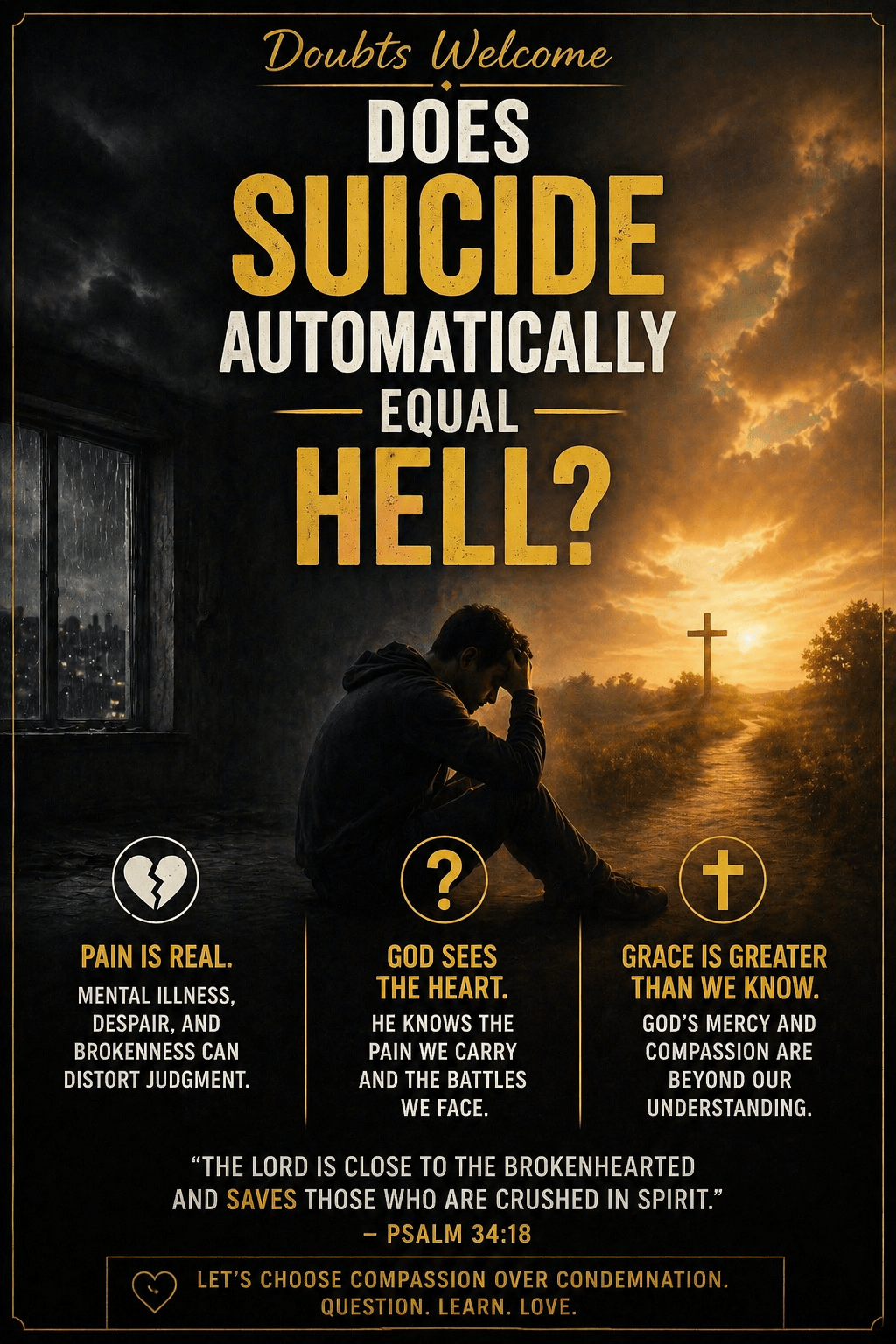
Psalms 34:18 (NIV)
“The Lord is close to the brokenhearted and saves those who are crushed in spirit.”
This is one of the most sensitive and painful questions people ask.
And it deserves more than a quick or harsh answer.
Because behind the question is often real hurt.
Real confusion.
Sometimes even personal loss.
So it’s important to approach this with honesty—and with compassion.
For a long time, some people were taught that suicide is an automatic condemnation.
That one act determines everything.
That there is no room for grace.
But when we look at the bigger picture of Scripture, it’s not that simple.
Salvation is not based on a single moment.
It’s not based on one action—good or bad.
It’s rooted in God’s grace.
In a relationship with Him.
If salvation depended on a final action being “perfect,” then none of us would have any certainty.
Because no one lives without struggle, failure, or moments of weakness.
And that includes mental and emotional battles.
Suicide is not just a theological issue.
It’s often connected to deep pain.
Depression.
Despair.
Feeling overwhelmed.
Feeling like there is no way out.
It’s not always a clear, rational decision—it’s often the result of intense suffering.
And that matters.
Because God sees more than actions.
He sees the heart.
He sees the pain behind it.
He understands what no one else fully can.
That doesn’t mean suicide is something to minimise.
Life matters.
It’s valuable.
And seeking help, support, and healing is important.
But the idea that one moment of deep pain can erase a lifetime of faith… doesn’t align with the depth of God’s grace.
The Bible consistently shows a God who is merciful.
Who understands human weakness.
Who meets people in their brokenness.
So rather than making absolute statements about someone’s eternal state, it may be more honest—and more biblical—to acknowledge what we don’t fully know.
Only God sees the full picture.
Only God understands every thought, every struggle, every moment leading up to that point.
And only God is the judge.
What we do know is this:
God is just.
God is merciful.
God is compassionate.
And His judgment is not shallow or simplistic.
It takes everything into account.
This question also challenges how we respond to people who are struggling.
Because sometimes, the focus becomes theology… instead of care.
Instead of asking:
“What happens after?”
Maybe we should also ask:
“How can we help before?”
How can we support people who are hurting?
How can we create spaces where people feel safe to speak?
How can we take mental health seriously—without shame or silence?
Because preventing pain matters more than debating outcomes.
And if someone has lost a loved one to suicide, the last thing they need is condemnation added to their grief.
They need compassion.
Understanding.
Space to process.
So maybe the question isn’t:
“Does suicide automatically equal hell?”
Maybe the better response is:
We trust God with what we don’t fully understand.
And we focus on reflecting His heart here and now.
A heart that draws near to the broken.
That doesn’t turn away from pain.
That meets people in their lowest moments.
Because this is not a topic for quick answers.
It’s one that requires care.
Sensitivity.
And a reminder of something important:
God’s grace is deeper than we often realise.
And His understanding is far greater than ours.
If you or someone you know is struggling, please don’t stay silent.
Reach out.
Talk to someone.
Seek support.
You’re not alone.
And your life matters more than you know.
 Doubts Welcome
Leave a comment