Proverbs 14:8
“The wisdom of the prudent is to give thought to their ways, but the folly of fools is deception.”
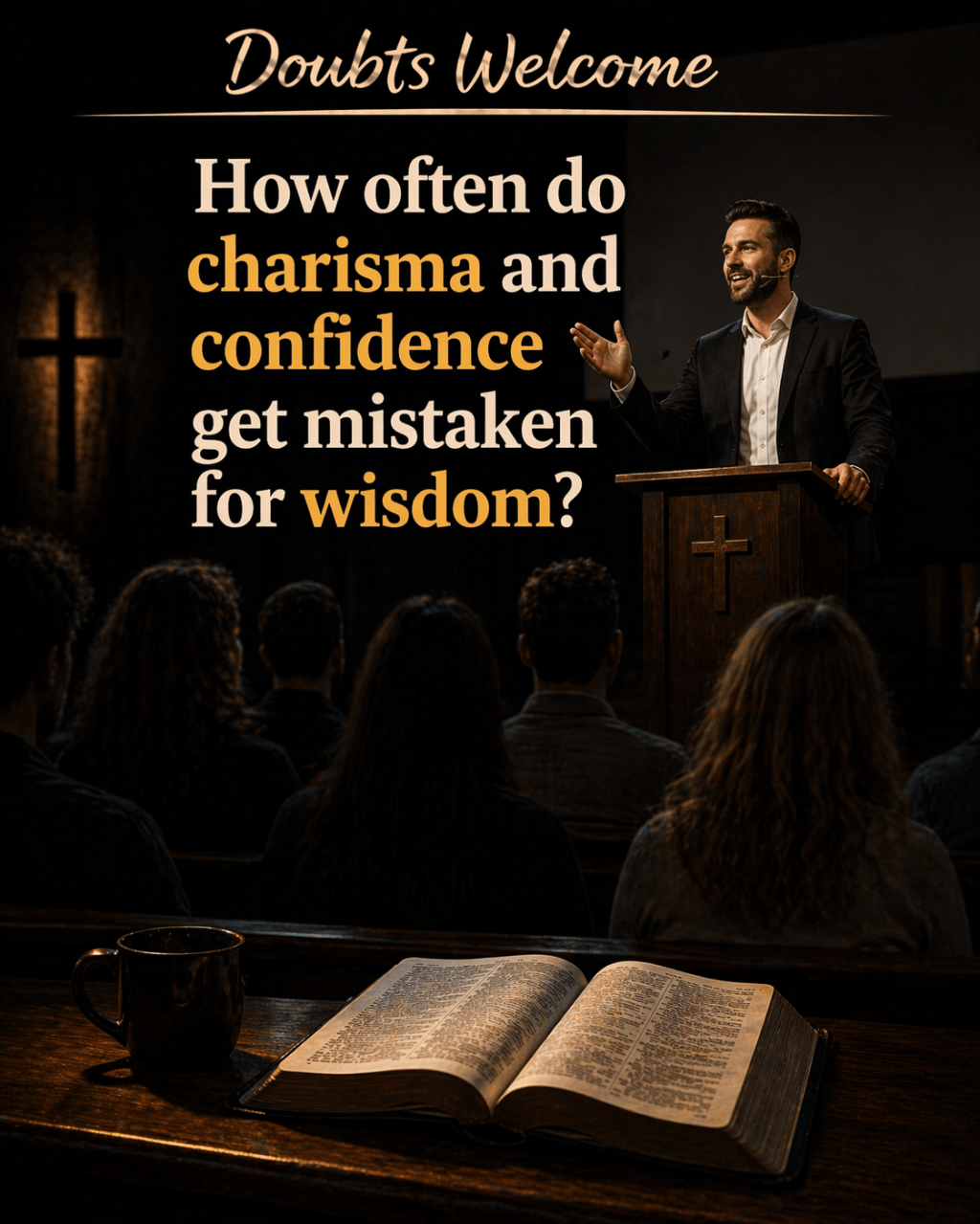
How often do charisma and confidence get mistaken for wisdom?
More often than we realise.
Because charisma is compelling.
Confidence is convincing.
And when someone speaks with clarity, energy, and certainty, it’s easy to assume they also speak with wisdom.
But those things are not the same.
Charisma can attract attention.
Confidence can hold it.
But wisdom?
Wisdom goes deeper.
It’s not just about how something is said—
it’s about what is being said… and how it is lived out over time.
The challenge is that charisma and confidence are visible.
They show up immediately.
In the way someone speaks.
The way they carry themselves.
The way they influence a room.
Wisdom, on the other hand, is often quieter.
It shows up in consistency.
In humility.
In the ability to listen, not just speak.
It’s not always loud or attention-grabbing.
Which means it’s easier to overlook.
This is why charisma and confidence can so easily be mistaken for wisdom.
Because they create an impression.
And impressions are powerful.
They can make someone seem trustworthy before they’ve actually been tested.
They can make ideas feel right before they’ve been examined.
And in environments where influence matters—like leadership, public speaking, or even church settings—this confusion can have real impact.
Because people tend to follow what feels convincing.
Not always what is truly wise.
But here’s the tension:
Confidence doesn’t equal correctness.
And charisma doesn’t equal depth.
Someone can speak with certainty… and still be wrong.
Someone can be engaging… and still lack understanding.
And if we’re not careful, we can mistake delivery for substance.
This doesn’t mean charisma or confidence are bad.
They can be strengths.
They can help communicate truth clearly.
They can inspire, encourage, and lead.
But they are tools—not indicators of wisdom.
Wisdom is revealed over time.
It’s seen in how someone handles pressure.
How they respond when challenged.
How they treat people when there’s nothing to gain.
It’s seen in humility—the willingness to admit,
“I don’t know.”
“I was wrong.”
Because real wisdom doesn’t need to prove itself constantly.
It doesn’t rely on being the loudest voice in the room.
It’s grounded.
Thoughtful.
Measured.
Open to learning.
Another reason this confusion happens is because we are often drawn to certainty.
Uncertainty can feel uncomfortable.
So when someone speaks with strong confidence, it can feel reassuring.
Even if what they’re saying hasn’t been deeply examined.
We prefer clear answers over complex ones.
Simple statements over nuanced thinking.
And confidence provides that.
But wisdom often sits in the tension.
It recognises complexity.
It allows for questions.
It doesn’t rush to conclusions.
And that can feel less appealing—because it requires patience.
There’s also a cultural element.
In many spaces, especially public ones, visibility is rewarded.
The most confident voices are often the most heard.
The most charismatic individuals are often the most followed.
And over time, influence can be mistaken for authority.
But being influential doesn’t necessarily mean being wise.
It just means being heard.
So how do we tell the difference?
We slow down.
We look beyond how something is said…
and pay attention to what is actually being said.
We observe patterns over time.
Does this person demonstrate humility?
Do they listen as much as they speak?
Are their actions consistent with their words?
We ask questions.
We test ideas.
We resist the urge to accept something just because it sounds good.
And maybe most importantly—we reflect on ourselves.
Because this isn’t just about who we follow.
It’s also about how we present ourselves.
Are we relying on confidence to appear certain?
Are we prioritising how we come across over what is true?
Because it’s possible to value being convincing… more than being accurate.
And that’s where growth comes in.
Because the goal isn’t to reject confidence or charisma.
It’s to not confuse them with wisdom.
To recognise that wisdom is something deeper.
Something developed.
Something lived out—not just spoken.
So how often do charisma and confidence get mistaken for wisdom?
More often than we think.
But maybe the better question is:
Are we willing to look deeper?
To not just be drawn in by what feels convincing—
But to seek what is actually true?
Because wisdom isn’t always the loudest voice.
But it’s the one that lasts.
 Doubts Welcome
Leave a comment