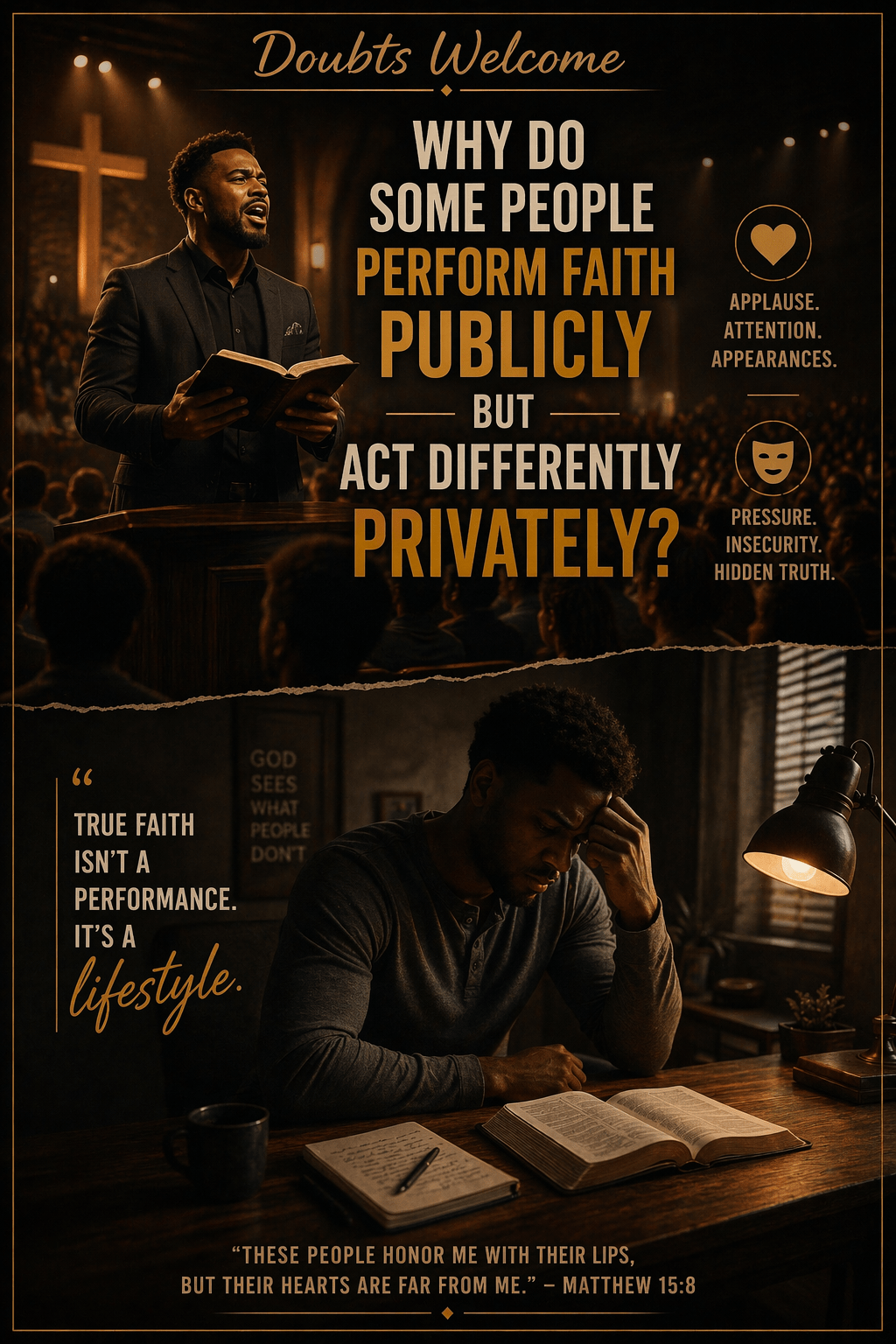
Matthew 15:8 (NIV)
“These people honor me with their lips, but their hearts are far from me.”
It’s a question many people have asked—sometimes quietly, sometimes out of frustration, sometimes out of hurt.
Because it’s hard to ignore the gap.
What is said publicly…
and what is lived privately.
The words.
The image.
The reality behind it.
And when those don’t match, it can feel confusing.
Even disappointing.
So why does this happen?
One reason is that faith can become something we present rather than something we live.
In public spaces—especially in church or on social platforms—there can be an unspoken pressure to look a certain way.
Put together.
Strong.
Certain.
To appear like you have it all figured out.
And over time, that pressure can lead to performance.
Saying the right things.
Acting the right way.
Fitting into what is expected.
Not always because someone is trying to deceive—but because they feel like they have to.
Because being honest can feel risky.
What if people judge?
What if you’re seen as weak?
What if you don’t “fit” anymore?
So instead of being real, people learn to perform.
Another reason is identity.
Sometimes people begin to tie their sense of worth to how they are seen spiritually.
Being known as “faithful.”
“Strong.”
“A leader.”
And when your identity becomes attached to that image, it becomes harder to be honest about your struggles.
Because honesty might threaten how people see you.
So instead of dealing with what’s happening internally, it gets hidden.
Managed privately.
Presented differently publicly.
And over time, the gap grows.
There’s also the reality that growth is a process.
No one lives perfectly.
People are still learning.
Still struggling.
Still working things out.
So sometimes what looks like inconsistency… is actually someone in progress.
But there’s a difference between growth and pretence.
Growth is honest, even when it’s imperfect.
Pretence hides, even when things are falling apart.
Another layer is that some people have never been shown what authentic faith looks like.
They’ve seen performance.
Heard the language.
Learned the behaviour.
But haven’t experienced the depth.
So they repeat what they’ve seen—without fully living it.
Not intentionally, but because it’s what they know.
And then there’s the influence of platforms.
Social media, church culture, public speaking—these spaces can amplify performance.
Because visibility can reward presentation.
What looks good.
What sounds right.
What gets attention.
And without realising it, faith can become something curated.
Something edited.
Something that looks right… but isn’t fully real.
But here’s the important part:
This isn’t just about “other people.”
If we’re honest, all of us can fall into this in some way.
Saying things we don’t fully live yet.
Presenting a version of ourselves that feels more acceptable.
Holding back parts of our story.
So maybe the goal isn’t just to point out the problem.
Maybe it’s to reflect.
Because the issue isn’t that people are imperfect.
It’s that sometimes there’s no space for honesty.
No space to admit:
“I’m struggling.”
“I’m unsure.”
“I don’t have this figured out.”
And when there’s no space for that, performance fills the gap.
So what’s the alternative?
Authenticity.
Not perfection—but honesty.
A faith that is lived, not just spoken.
A willingness to align what is public… with what is private.
Even if that means being vulnerable.
Even if that means not always having the right words.
Because real faith isn’t about image.
It’s about transformation.
And transformation happens in the private places.
In the unseen moments.
In the choices no one else notices.
So maybe the question isn’t just:
“Why do some people perform faith?”
Maybe it’s:
“Am I living what I say I believe?”
Because the most powerful kind of faith isn’t the one that looks the best publicly.
It’s the one that is real—both publicly and privately.
And maybe that kind of faith…
is what people are actually searching for.
 Doubts Welcome
Leave a comment