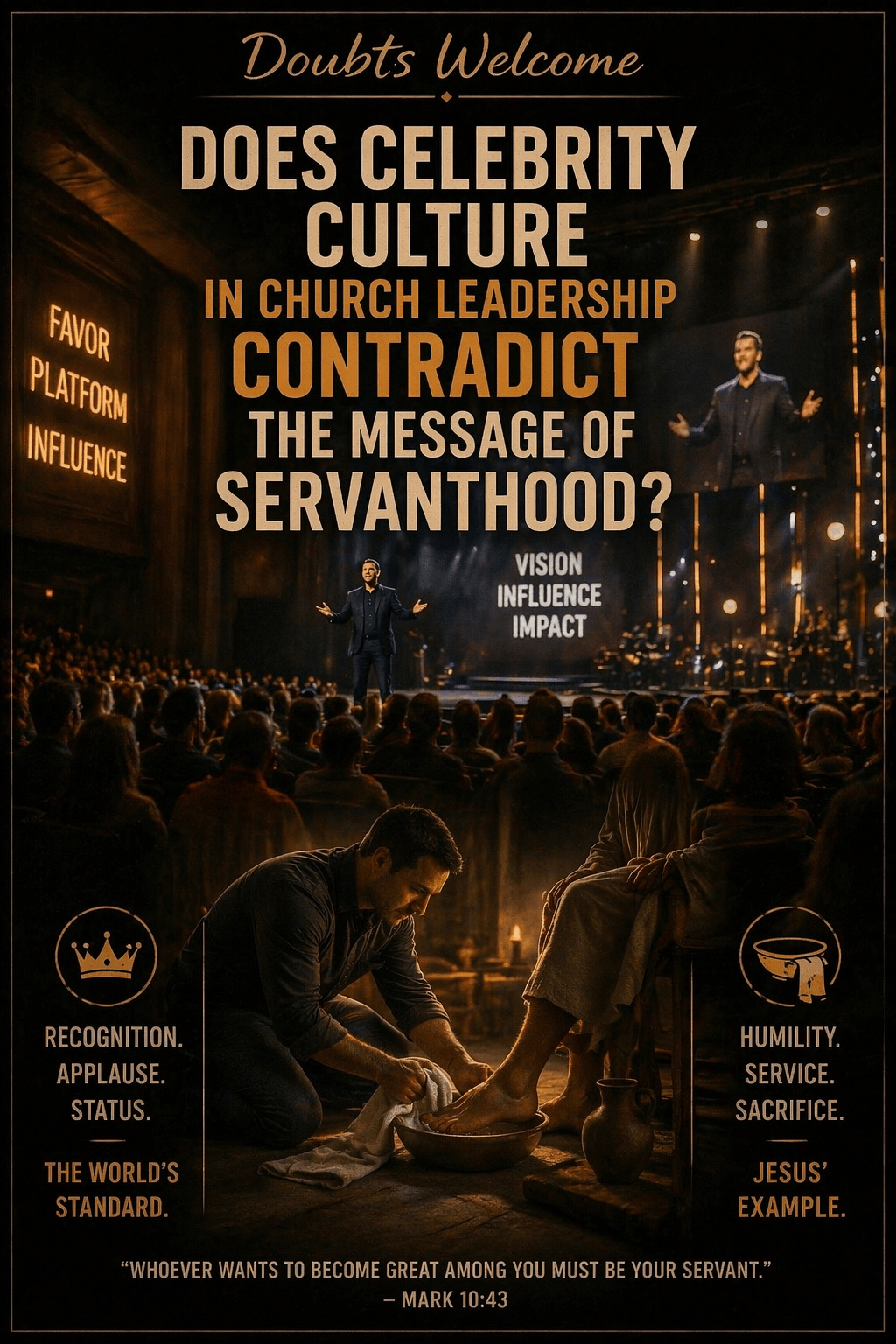
Matthew 20:26 (NIV)
“Whoever wants to become great among you must be your servant.”
It’s a question that more people are starting to ask.
Because in many spaces, church leadership can begin to look… elevated.
Platforms get bigger.
Voices get louder.
Names become widely recognised.
And over time, it can start to feel less like leadership—and more like celebrity.
So where does that leave servanthood?
Because at the heart of Christianity is a very different model.
Jesus didn’t lead by elevating Himself above people.
He served.
He humbled Himself.
He washed feet.
He spent time with those others overlooked.
He didn’t build distance—He built connection.
So when leadership begins to look like status, influence, and recognition, it’s worth asking:
Are we still reflecting that same model?
Now, to be clear—visibility isn’t the problem.
Having a platform doesn’t automatically mean someone is prideful.
Being influential doesn’t mean someone isn’t serving.
The issue isn’t being known.
It’s what happens when being known becomes the focus.
Because celebrity culture can shift things subtly.
It can create distance between leaders and people.
It can make accountability more difficult.
It can turn influence into identity.
And sometimes, it can place leaders in positions where they are admired… but not truly known.
And that’s where the tension grows.
Because servanthood isn’t about being seen.
It’s about how you live when no one is watching.
It’s about humility.
Accessibility.
A willingness to serve without needing recognition.
And if we’re not careful, we can begin to value charisma over character.
Platform over presence.
Influence over integrity.
Not just in leaders—but in what we, as a community, celebrate.
Because celebrity culture doesn’t just exist because of leaders.
It’s also sustained by what people elevate.
Who we follow.
Who we promote.
What we reward.
So this isn’t just a leadership question—it’s a collective one.
What are we drawn to?
Are we more impressed by influence…
or by humility?
Do we value visibility…
or faithfulness?
Because it’s possible for someone to have a large platform and still carry a servant’s heart.
But it requires intentionality.
It requires staying grounded.
Remaining accountable.
Keeping the focus on people—not position.
So maybe the question isn’t:
“Is celebrity culture always wrong?”
Maybe it’s:
“Is it shaping leadership away from servanthood?”
Because the example Jesus gave wasn’t about building a following.
It was about serving others.
And maybe real leadership still looks like that—
Even if it’s not always the most visible.
Because in the end, the goal was never to be elevated.
It was to be faithful.
And to serve well.
 Doubts Welcome
Leave a comment