2 Timothy 3:16 (NIV)
“All Scripture is God-breathed and is useful for teaching, rebuking, correcting and training in righteousness.”
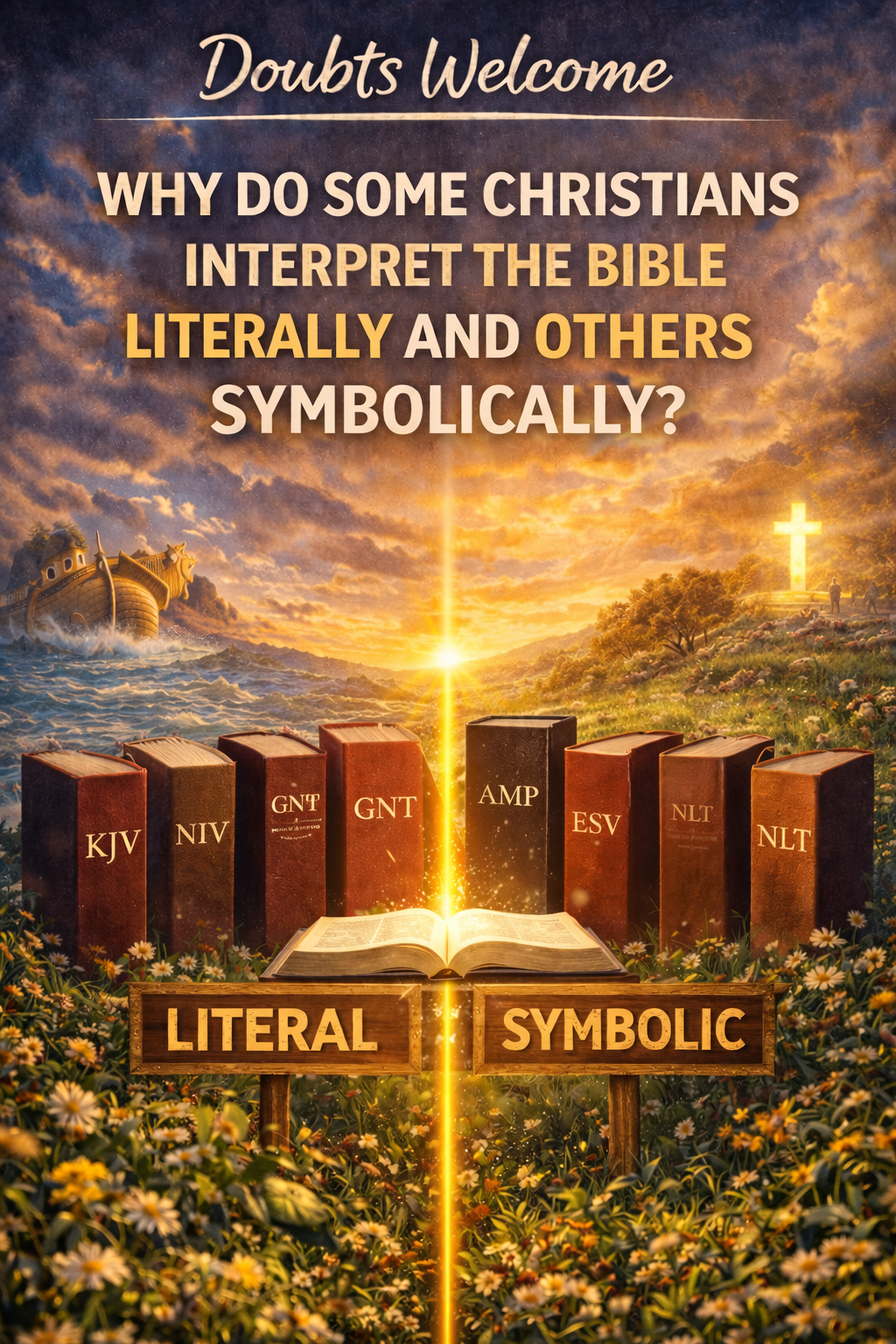
It’s a question that can feel confusing—especially when people are reading the same Bible but coming to different conclusions.
And if we’re honest, it can sometimes feel frustrating too.
“How can one book have so many interpretations?”
“Why don’t Christians all agree?”
Part of the answer starts here:
The Bible isn’t just one type of writing.
It includes history, poetry, parables, prophecy, and letters. Each of these communicates truth—but not always in the same way.
Poetry uses imagery and metaphor.
Parables use stories to reveal deeper meaning.
Prophecy often includes symbolic language and visions.
So the question becomes:
Should everything be read the same way?
Some Christians lean toward a more literal approach.
They believe the Bible should be taken at face value unless there’s a clear reason not to. For them, this protects the authority of Scripture and keeps interpretation straightforward.
Others recognise that certain parts of the Bible were never meant to be read literally.
They look at context, literary style, and historical background to understand what the text is really communicating.
For them, reading symbolically doesn’t weaken the message—it helps uncover its depth.
So the difference isn’t always about taking the Bible seriously or not.
Both perspectives are often trying to honour Scripture.
They just approach it differently.
But there’s another layer to this…
Why are there different interpretations in the first place?
Because people bring different things to the text.
Different backgrounds.
Different cultures.
Different church teachings.
Different life experiences.
All of these shape how we read and understand Scripture.
Two people can read the same passage—
and notice different things.
And that doesn’t always mean one is right and the other is wrong.
Sometimes it means the Bible is deeper than a single perspective.
There’s also the question of Bible versions.
The Bible was originally written in Hebrew, Aramaic, and Greek—not English.
So what we read today are translations.
Some translations aim to be very word-for-word.
Others focus more on thought-for-thought to make it easier to understand.
That’s why different versions can sound slightly different—even though they are communicating the same core message.
And sometimes, those differences can influence how a passage is understood.
So when you combine:
Different literary styles,
Different backgrounds,
Different translations—
It’s not surprising that interpretations can vary.
But maybe that’s not something to fear.
Maybe it’s something to approach with humility.
Because the goal isn’t just to be “right.”
It’s to understand.
To grow.
To seek truth honestly.
So maybe the real question isn’t:
“Why are there so many interpretations?”
Maybe it’s:
“Am I willing to learn, listen, and go deeper?”
Because the Bible isn’t just a book to read quickly.
It’s something to wrestle with.
Reflect on.
Grow through.
And sometimes, that journey includes questions.
And that’s okay.
 Doubts Welcome
Leave a comment