Psalms 19:1 (NIV)
“The heavens declare the glory of God; the skies proclaim the work of his hands.”
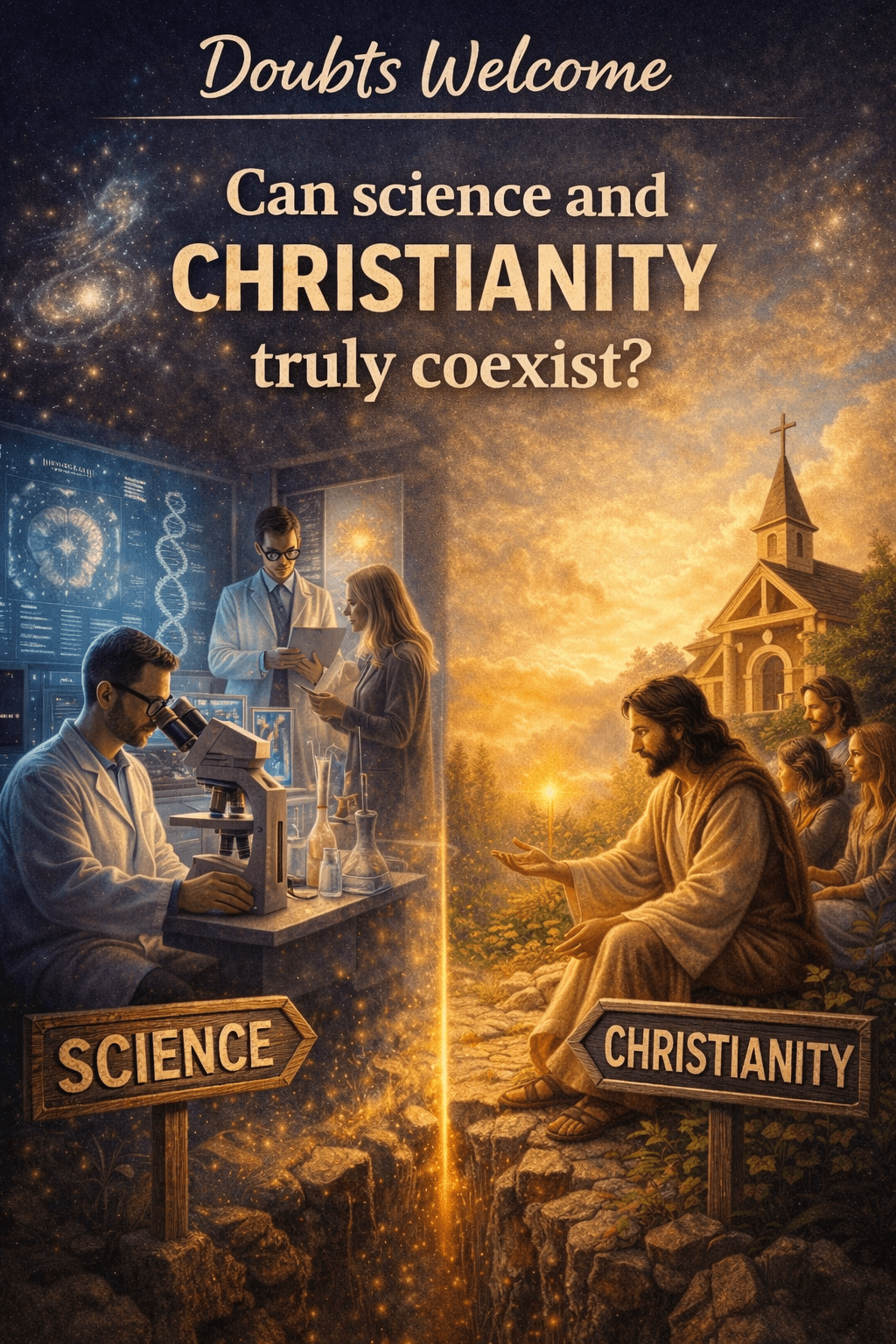
For many people, this feels like an either/or question.
You’re either someone of faith…
or someone who trusts science.
As if the two are constantly in conflict.
As if choosing one means rejecting the other.
But is that really true?
Or have we misunderstood what each one is meant to do?
Science, at its core, is about exploring how the world works.
It asks questions like:
How did this happen?
What processes are involved?
What can be observed, tested, and measured?
It looks at patterns, evidence, and explanations.
Christianity, on the other hand, speaks more to meaning.
Why are we here?
What is our purpose?
Who is God?
What does it mean to live a life of faith?
It deals with identity, purpose, morality, and relationship.
So in many ways, they’re not answering the same questions.
They’re approaching reality from different angles.
Science explains the mechanisms.
Faith explores the meaning behind them.
The tension often comes when we expect one to replace the other.
When science is used to dismiss anything beyond what can be measured…
or when faith is used to ignore evidence, curiosity, or discovery.
But what if they were never meant to compete?
What if they were meant to complement each other?
Throughout history, many scientists were also people of faith—people who saw their work not as a contradiction to belief, but as a way of understanding creation more deeply.
For them, studying the universe wasn’t separate from faith.
It was part of it.
Because when you look closely at the world—its complexity, its order, its beauty—it can lead to awe.
To wonder.
To deeper questions.
And for some, that doesn’t take them away from God—it draws them closer.
At the same time, faith doesn’t require rejecting science.
It doesn’t mean turning away from evidence or denying discovery.
It means recognising that not everything meaningful can be measured.
Love can’t be quantified.
Purpose can’t be tested in a lab.
Hope can’t be reduced to data.
There are aspects of life that go beyond what science can fully explain.
And that doesn’t make science wrong—it just means it has limits.
In the same way, faith also requires humility.
It acknowledges that we don’t have all the answers.
That there are mysteries we may not fully understand.
And that’s okay.
Because both science and faith, at their best, begin with a willingness to ask questions.
To explore.
To seek understanding.
So maybe the question isn’t:
“Can science and Christianity coexist?”
Maybe it’s:
“Are we willing to let both shape how we see the world?”
Because it’s possible to explore the world through science…
and still believe there is meaning, purpose, and a Creator behind it.
It’s possible to study the details…
and still be moved by the bigger picture.
Not everything has to be a conflict.
Sometimes, it can be a conversation.
And maybe it’s in that conversation—
that a deeper, more complete understanding begins.
 Doubts Welcome
Leave a comment